What changes in everyday work?
What the team gains

A clear offer from the start
Customers quickly understand what you do, who you work with and which problem you help solve. They find the details where they expect them.
Character expressed in the details
Typography, photography, graphics and motion form a consistent brand language. Interactions reinforce the content while forms and navigation remain easy to use.
A structure ready to grow
Services and subjects get their own URLs when they address distinct needs. The website can expand without putting everything on the homepage.
First, answer the questions customers bring with them.
Someone referred by a friend looks for reassurance about quality. A visitor arriving from search may still be comparing approaches. Another person simply needs to check the scope and find a contact option. We organise the content so these paths are clear and do not end at a vague promise of comprehensive service.
A service page explains the problem, the work involved, the way we collaborate and the answers to common concerns. We describe completed projects using verified materials. When showing a visualisation or illustrative use case, we label it clearly; an attractive image should not pretend to be evidence of delivered work.
- Business websites and extensive service websites.
- Offer, use-case and industry pages with distinct content.
- Landing pages for a clearly defined campaign or product.
- Project libraries, guides and question-and-answer sections.
SEO starts with sensible information architecture.
We structure pages around what customers want to understand. Each important page has its own subject, clear heading, title and description. Links connect services to relevant examples and guides. We do not multiply pages that differ only by a town name or a few substituted words.
The technical work includes content available in HTML, correct URLs, navigation, metadata and indexing rules. When replacing an existing website, we plan redirects from old addresses. Structured data describes what is actually on the page, while a sitemap identifies the URLs intended for discovery.
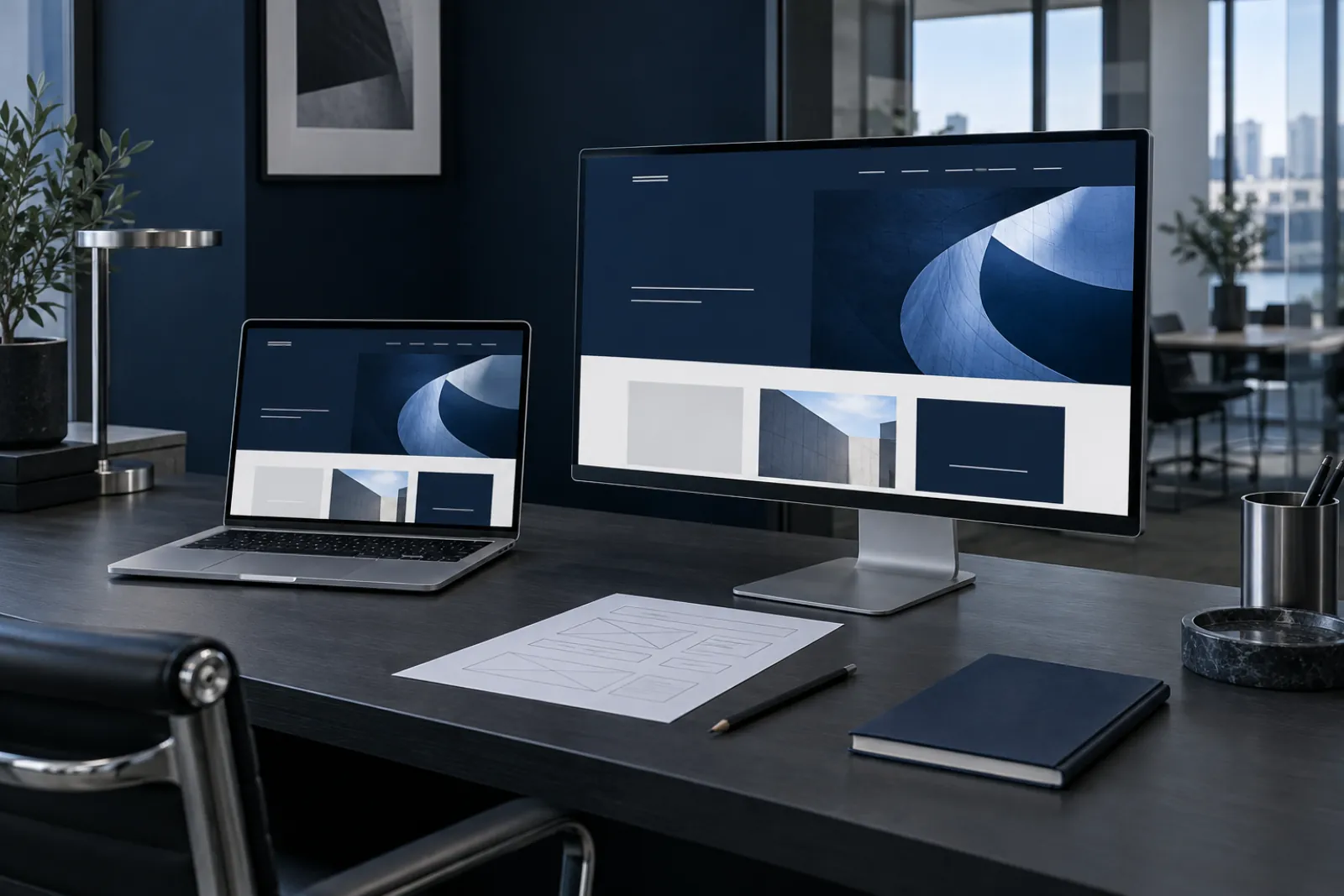
Visual impact should work beyond fast Wi-Fi.
We prepare photographs and generated graphics for their specific place, with the right framing, size and format. Heavier materials such as decorative video should not block the first view or access to contact. A visitor with limited data must receive the complete content even without animation.
We check readability, contrast, keyboard navigation and forms. On phones, comfortable input fields, sensible section lengths and contact without searching for a tiny link matter. Motion effects respect the reduced-motion preference on the user’s device.
A good website needs material that is genuinely yours.
Before design begins, we gather the service scope, customer questions, working process and materials the business has the rights to use. We help organise the content and identify gaps. Where photographs are missing, we can plan new material or create original illustrations that explain a process.
- Which services matter most, and who are they for?
- What does a customer need to know before making contact?
- Which projects, photographs and information can be published?
- Who will update the offer, and how often?
From the first conversation to launch
Offer and structure
We define audiences, page subjects and intended actions. This produces a content plan and a list of required materials.
Design and development
We combine the visual design with real content. We build responsive views, navigation and the agreed website functionality.
Publication and verification
We check URLs, forms, metadata and device behaviour. We agree how updates and further content development will work.
Questions worth asking
Will the website be prepared for SEO?
Yes, within the agreed content structure and technical implementation. Rankings also depend on competition, the overall quality of the domain and ongoing work. A website project alone cannot guarantee a particular position in Google.
Is a one-page website or a multi-page site better?
One page may be enough for a very narrow offer. Where services and customer questions differ, separate pages explain each subject in more depth and guide users to the relevant part of the offer.
Will we be able to edit the content ourselves?
Yes, if that way of working is included in the scope. The editing system depends on who maintains the site, how often and which elements they should be able to change without affecting the layout.
Can we keep our current domain and URLs?
Usually, yes. During a rebuild, we review existing URLs and materials. Content moving to new paths receives redirects rather than leaving visitors with broken links.